
Geometry learn v3 not just a words concerning shapes and college mathematics. It serves well as a quick description of a contemporary visual sequential method to learn geometry. Geometry is the field of study that examines lines, angles, shapes, space, and the relationship between objects. It gives students a clearer understanding of the world A door, a clock, a road sign, floor tiles, the screen of your phone, and football field all house geometry within. Don’t get me wrong; it’s not just about formulas and memory.
The end goal is to see patterns, explain ideas and solve problems with confidence. Two of those elements are also key parts of what respected math standards expect if we use strong geometry learning practices: visual thinking and spatial reasoning.
What Is Geometry Learn V3?
Geometry learn v3 algorithm — you could think of as a digital mini Mat, for novices. It is referred to as GL within the public Geometry Learn V3 page under “The GL Series,” with sections for games, apps, extras and settings. That teaches us one major lesson. It’s more than just reading dry notes. This points to a better mode of learning, which is interactive. A student uses this concept for learning geometry with brief lessons, visual illustrations, easy practice problems, and physical objects.
This matters due to the fact that a good deal extra manipulation of concepts, no longer just staring at formulas is less difficult to do when scholars can visualize and roll around concepts. A well designed learning system makes students start with lines and shapes before gaining deep insights into areas, volumes, symmetry, coordinates and proofs.
Why Geometry Learn V3 Matters for Students
Geometry learn v3 matters because many students struggle with geometry for the wrong reason. They think the subject is only about rules. In truth, geometry is about seeing space clearly. The National Council of Teachers of Mathematics says geometry learning should include analyzing shapes, using coordinate systems, applying transformations, and using visualization and modeling to solve problems.
That is a big clue. Students should not only answer questions. They should build, draw, turn, compare, and explain. This approach helps weak learners become steady learners. It also helps strong learners think more deeply. When geometry is taught with pictures, objects, and simple language, students can connect math to real life instead of treating it like a locked box.
The Best Way to Start Learning Geometry
The best way to start geometry is with the smallest ideas first. Do not jump into theorems, proofs, and hard formulas too early. Start with points, lines, rays, line segments, angles, and simple shapes. Geometry learn v3 works best when each idea builds on the last one. A point shows a position. A line continues forever. A line segment has two ends. A ray starts at one point and moves in one direction. These ideas look tiny, but they are the roots of the whole subject. When students skip them, harder topics become messy. A strong learner draws each idea, labels it, says it aloud, and then solves a few simple problems. That small routine builds real control.
Points, Lines, Rays, and Segments
Points, lines, rays, and segments are the alphabet of geometry. Without them, shapes and angles become confusing. A point is like a dot on a map. It has a place, but no size. A line is straight and endless in both directions. A ray has a starting point and keeps moving one way. A line segment is the part of a line between two points.
School Yourself describes geometry as the mathematics of lines, shapes, and angles, which is essential for describing the world around us. This is why the basics matter. Students should not only read these definitions. They should draw them many times. The hand teaches the brain faster than silent reading alone.
Understanding Angles in a Simple Way
Angles are one of the most helpful things we have in geometry! A ray from point A to point B forms an angle. The vertex is the meeting at that point. Make angles mundane with Geometry learn v3 — not strange. Angles should be,also, demonstrated by a door opening, clock hands moving,cissors cutting and roads crossing. An acute triangle is less than a right angle. A right angle is at 90 degrees — no more, nothing less.
An obtuse angle is between 90 and 180 degrees. A straight angle measures 180 degrees. The basic geometry course in Khan Academy includes angle measure along with length, area, perimeter, volume and transformations. Model Use A Protractor The protractor should be used by the students frequently. Guessing angles is weak practice. Measuring angles builds accuracy.
Shapes and Polygons Made Clear
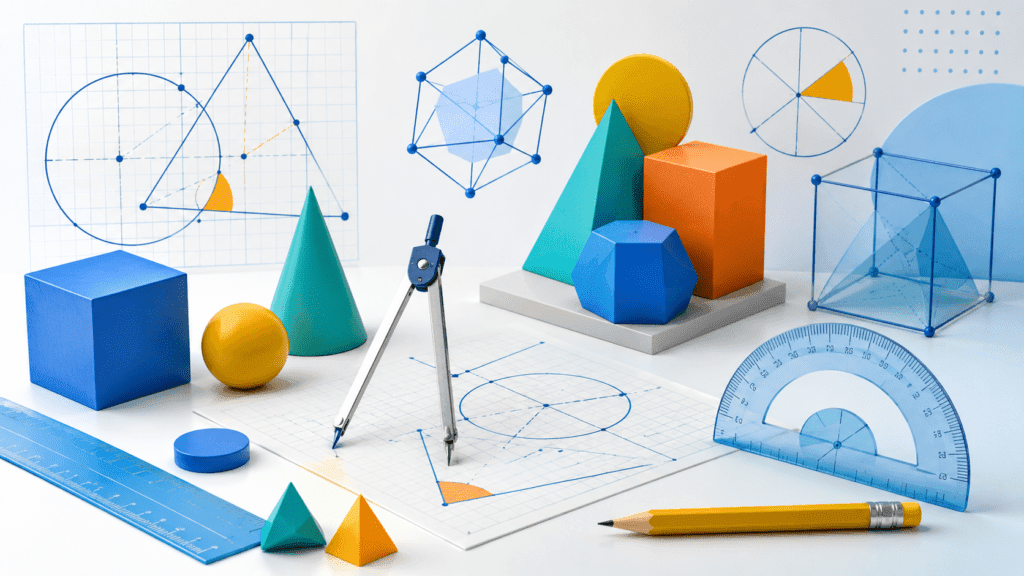
Shapes are not just names to memorize. Each shape has features that make it special. A triangle has three sides. There are four right angles and four equal sides in a square. A rectangle has four right angles, but opposite sides match. A polygon is a closed flat shape made from straight sides.
Geometry learn v3 should teach students to ask useful questions about every shape. How many sides does it have? Are the sides equal? Are the angles equal? Can it be split into smaller shapes? These questions train the eyes to notice structure. This is important because geometry is not random. Shapes follow patterns. When students learn to spot those patterns, they stop guessing and start reasoning.
Triangles: The Shape That Builds Strong Thinking
Triangles are basic, however they are effective. You can find them in bridges, roofs, towers, sign, art maps game design. A Triangle have three sides and three angles. In all triangles, the angle sum property is 180. Triangle is an example of a concept that Geometry learn v3 must work hard on because it teaches balance,comparison and proof.
These are equilateral, isosceles and scalene triangles. Acute, right and obtuse triangles are the others. These are the rules that students learn to solve for missing angles, sides questions or real-world design problems using triangle diagrams.
Abstract Common Core Geometry standards also connect geometrical learning to congruence, similarity, physical models and some simple geometry software as well as the Pythagorean Theorem. Triangles are small math engines. They have far greater power than they appear to.
Circles, Radius, Diameter, and Circumference
Circles look simple, but they hold many important ideas. A circle has a center. From the center to the edge, the radius extends. The diameter goes across the full circle through the center. The circumference is the circle’s circumference. Geometry learn v3 should teach circles through real objects first. A plate, coin, wheel, clock, button, and round table all help students understand circle parts. Once the parts are clear, formulas become less scary.
Students often mix up radius and diameter. A useful rule is simple. The diameter is twice the radius. The radius is half the diameter. Before using formulas, students should draw a circle and label each part. That small step prevents many mistakes.
Area and Perimeter Without Confusion
One can easily confuse area and perimeter, but the distinction is straightforward. The perimeter of a shape is its circumference. Area is the amount of space within a shape. Now this is what geometry learn v3 should show with real examples. Imagine a garden. The perimeter is the fence that surrounds the garden. Area is grass in the garden. For a rectangle: area = length * width You can think of a perimeter as the sum of all the sides.
The area and perimeter unit in Khan Academy starts by introducing rectangles, before doubling down on triangles, circles and other shapes. It is logical then because students have to be confident before the next shapes are encountered which become harder. The ultimate question, however, is this: around the shape or inside the shape?
Volume and 3D Geometry
Flat shapes are two-dimensional. Solid shapes are three-dimensional. A square is flat. A cube is solid. A circle is flat. A sphere is solid. Geometry learn v3 should help students move from drawings to real objects. A box is a rectangular prism. A can is a cylinder. A ball is a sphere. A cone is an ice cream cone.
Volume tells how much space a 3D object holds. Surface area tells how much outside covering it has. Common Core standards include solving real-world and mathematical problems involving the volume of cylinders, cones, and spheres. This topic becomes much easier when students use objects they can touch. Real objects make abstract ideas behave.
Transformations, Symmetry, and Movement
Transformations show how shapes move. A translation slides a shape. A reflection flips it. A rotation turns it. A dilation makes it larger or smaller. Geometry learn v3 should include movement because many students understand better when they can watch a shape change.
Common Core high school geometry standards include developing definitions of rotations, reflections, and translations using angles, circles, perpendicular lines, parallel lines, and line segments. Symmetry also matters. A shape has line symmetry when one side mirrors the other. Many letters, leaves, tiles, logos, and buildings use symmetry. These ideas are useful in art, design, animation, architecture, and computer graphics. Geometry is not frozen. It moves, flips, turns, and grows.
Coordinate Geometry and the Grid
Coordinate geometry makes the connection between shapes and numbers. Two number lines are used in a coordinate plane. The horizontal line represents the x axis. Line vertical is y axis. A point is an ordered pair, such as (3, 2). The slow teaching of geometry learn v3 the grid is so that they can link visual thinking with number thinking. You are a student plotting points and shapes, calculating distances and transformations on the coordinate plane.
That is where geometry will begin to shake hands with algebra. Also does it for maps, games and coding robotics and design software. Locating and using spatial relation is part of geometry learning emphasized by NCTM (National Council of Teachers of Mathematics, 2000). A grid converts space into a commodity students can quantify.
Proofs and Logical Thinking
Proofs are often the part students fear most. That fear is normal, but it can be fixed. A proof is just a clear explanation that shows why something must be true. Geometry learn v3 should treat proofs like a calm conversation, not a courtroom battle. Students need to learn definitions, facts, and reasons one step at a time.
For example, if two angles form a straight line, their measures add to 180 degrees. If a triangle has two equal sides, some related angles will match. Proofs teach students to avoid guessing. They also teach clear thinking. This skill is useful beyond math. It helps with arguments, writing, planning, coding, and decision-making. A good proof is simply organized truth.
Spatial Reasoning: The Hidden Skill Behind Geometry
Spatial reasoning which means studying the objects, movement, space and position of things around. It gets students to mentally flex shapes, which, in turn helps them envision how they will wrap, twist and overlap. Core Math Learn v3 has this skill baked in because math learning is so closely correlated with language.
According to one recent research report published in 2022, spatial thinking is essential for discovery, learning and communication across all math domains. Another recent study also investigates relationships between spatial reasoning skills and mathematics learning.
Which means, geometry is still not only for school tests. Trains the brain to identify structure. We know that spatial reasoning can be improved through activities such as drawing shapes, folding paper, using blocks, working with grids and puzzles and rotating objects, plus it is not too difficult for most students. The more they practice, the more precise their inner map is.
How to Practice Geometry Learn V3 the Smart Way
Geometry learn v3 should be practiced with a clear routine. First, read the idea in simple words. Second, draw a picture. Third, label every known part. Fourth, write the formula or rule. Fifth, solve the problem slowly. Sixth, check the answer. This routine sounds basic, but it works because it removes panic. Students’ haste results in a lot of incorrect responses. They forget the units, use the wrong formula, or skip the diagram.
Smart practice is not doing one hundred random questions. Smart practice is doing fewer questions with full attention. A mistake notebook should be kept by a student. Each mistake should include the wrong step, the correct step, and one short lesson. That notebook becomes a private treasure map.
Common Geometry Mistakes to Avoid
The most common mistake is memorizing formulas without knowing what they mean. The second mistake is confusing similar words, like area and perimeter or radius and diameter. The third mistake is drawing messy diagrams. Geometry learn v3 should help students slow down and build accuracy. A messy diagram can turn an easy question into a swamp. Another common mistake is ignoring units. Area uses square units, like square centimeters. Volume uses cubic units, like cubic meters. Additionally, students are unaware that not all pictures are drawn to scale. That means a shape may look equal or straight, but the facts must prove it. Geometry rewards careful eyes. It punishes sleepy guesses.
Real-Life Uses of Geometry
There are more places where geometry comes in handy than students expect. It is used by builders to design rooms, walls, roofs, and bridges. For artists it is a big part of what you use for balance, patterns and perspectives. Designers use it for layout, furniture, products, logos, and more. Angles are used by athletes in shots, passes, movement and field position. Geometry, how gamers draw their maps, collision, movement, even 3D worlds.
Geometry learn v3 you need to make real connections with these examples. When students can observe geometry occurring in their daily life, the subject appears less like homework and is more like a tool. Angles can be taught through a pizza slice. A boxed cereal can inform volume. Tiling a floor can be used to teach students area and symmetry. All day the world quietly does math.
A Simple 7-Day Geometry Learn V3 Study Plan
A short study plan can make geometry feel less heavy. On day one, study points, lines, rays, and segments. On day two, learn angle types and measure angles. On day three, review triangles and their angle rules. On day four, study quadrilaterals and polygons. On day five, practice area and perimeter. On day six, learn circles, radius, diameter, and circumference. On day seven, review 3D shapes, volume, and surface area.
Geometry learn v3 works best when students study in short, focused sessions instead of long, tired sessions. Each day should include drawing, labeling, solving, and explaining. The explaining part matters most. If you can explain a topic simply, you probably understand it.
Best Tools for Learning Geometry Better
The best geometry tools are simple. A ruler helps with straight lines. A protractor helps with angles. Graph paper helps with coordinate geometry. Plain paper helps with free drawing. Digital geometry tools can help students move, rotate, resize, and test shapes. Geometry learn v3 should use both paper and screen practice. Paper builds hand control. Digital tools build movement and visual testing. T
he National Academies describes spatial thinking as a mix of space concepts, representation tools, and reasoning processes. That means students need more than memorized notes. They need tools that help them represent and reason. A good learner uses the right tool at the right time, like a tiny math carpenter.
Final Thoughts
Geometry learn v3 is most powerful when it makes geometry clear, visual, practical, and human. Students should not treat geometry as a pile of cold formulas. They should treat it as a way to understand space, shape, movement, and design. Start with simple ideas. Draw often. Label everything. Use real objects. Practice short sessions. Keep mistakes. Review them without shame. The learner who improves in geometry is not always the fastest learner.
It is usually the learner who stays steady and pays attention. Geometry teaches more than math. It teaches patience, proof, structure, and clear thinking. Once students begin to see geometry in the world around them, the subject becomes much less scary.
FAQs
What is geometry learn v3?
In this section, geometry learn v3 is pretty much a modern compact way to phrase for visual geometrical learning. It might include lessons on steps, digital tools, apps, diagrams, and apps. Its key focus is to enable students to learn and understand shapes, angles, space, area, volume, symmetry and motion in a better way.
Is geometry learn v3 good for beginners?
Yes, but it would be best for novice if it begins with an elementary concepts. Start with points, lines, rays, segments, angles and what shapes are pretty basic for a newcomer. Then they can start exploring triangles, circles, area and perimeter, volume, transformations and proofs with much less confusion.
Why is geometry hard for many students?
Since geometry involves pictures, words, numbers and logic it is a struggle. For example, a student might look at a shape and know what it is but may not be able to articulate why a rule works. The solution is practicing with drawings, labels, examples from real life and verbal explanations. Rushing makes geometry harder.
How can students improve geometry quickly?
Students can draw every problem, label known facts, write the rule at the top first and solve step by step. They must also analyze their mistakes instead regretting from it. It is better to have ten meticulous problems than fifty hurried ones. In geometry, clear thinking is more valuable than speed.
What topics should I learn first in geometry?
Start with points, lines, rays, line segments, and angles. Then study triangles, quadrilaterals, polygons, circles, area, and perimeter. After that, move into volume, surface area, coordinate geometry, transformations, symmetry, congruence, similarity, and proofs. This order keeps the learning path smoother.
Can geometry help in real life?
Yes, geometry is used in building, art, maps, games, design, sports, coding, engineering, and daily problem-solving. It helps people understand size, shape, distance, position, and movement. Even simple activities like arranging a room, reading a map, or cutting paper use geometry thinki